
Concrete polishing
Concrete overlays in San Diego
Overlays cover imperfections and give existing concrete a new look, often for less than removing and replacing it.
Overview
A new surface without replacing the slab
Want concrete that looks better, or need to cover imperfections in the concrete you already have? A concrete overlay can do both. If you do not like the look of your concrete, an overlay gives it a new appearance at a much lower cost than tearing it out and replacing it.
A polymer-modified cementitious overlay bonds to almost any properly prepared surface while keeping the properties of concrete. Overlays can be applied to flat and vertical surfaces, and to other surfaces such as wood decks, an option if you are tired of staining and sealing your deck every year.
Installation matters. Overlays should be applied by professionals, following the manufacturer’s instructions.
Service at a glance
- Best for
- Covering imperfections and giving existing concrete a new look
- Surfaces
- Flat and vertical surfaces, and other surfaces such as wood decks
- Good to know
- Often costs much less than tearing out and replacing the concrete
- Service family
- Concrete Polishing
Before choosing an overlay
Is your concrete a good candidate for an overlay?
An overlay needs a sound base. It changes the surface, not the slab underneath, so the existing concrete is evaluated first.
Usually a good fit
- Sound concrete with surface imperfections, stains or a worn look
- A surface you want to change completely, such as giving it a stone, brick or tile pattern
- Walls and other vertical surfaces as well as floors
- A surface that can be properly prepared so the overlay bonds
Dealt with first
- Cracks and damaged areas, which are repaired before the overlay goes on
- Loose, flaking or weak surface material
- Old coatings or sealers
- Cracks from movement or damage that may be structural, which should be evaluated before any overlay is planned
See concrete repair.
Overlay types
Four main types of concrete overlay
Each type works differently. We help you choose the one that fits your surface and the look you want.
| Type | What it is | Best for |
|---|---|---|
| Micro-toppings | Thin skim coats, usually about an eighth of an inch thick. Flexible, and can be colored with dyes, dry pigments or integral color. | Surfaces that can only take a very thin layer; refreshing worn concrete on floors and walls. |
| Stamped overlays | Thicker cement-based overlays that can be stamped and colored to look like tile, brick, wood or stone. | Indoor and outdoor surfaces that should resemble natural materials. |
| Self-leveling overlays | Flowable overlays that level themselves, spread with metal squeegees. They have a limited working time and must be mixed and installed correctly. | A new look for interior floors, or an underlayment for other flooring. See self-leveling. |
| Multipurpose overlays | Sand-based overlays applied with a trowel, broom or hopper gun. | Sprayed and troweled textures and creative designs. |
Compare services
Overlay, resurfacing or self-leveling?
An overlay adds a new decorative layer to sound concrete. Resurfacing is the broader job of restoring a worn or damaged surface, often with an overlay or a coating. Self-leveling is a flowable layer used to smooth uneven floors.
| Concrete overlay | Resurfacing | Self-leveling | |
|---|---|---|---|
| What it is | A polymer-modified cementitious layer bonded to the existing surface | Covering an old, weak or damaged surface with a thin layer of coating or concrete | A flowable, concrete-like material that evens itself out |
| Main purpose | A new look: patterns, textures and color | Restoring worn or damaged concrete | Smoothing uneven or low spots, as an underlayment or a finished floor |
| Typical surfaces | Floors, walls, patios and decks | Pool decks, driveways, patios, interior and commercial floors | Mainly interior floors |
| Finish options | Stamped patterns, sprayed textures, micro-toppings and color | Overlays, spray textures, or epoxy, polyaspartic and polyurethane coatings | A smooth surface, with color added if wanted |
See concrete resurfacing and self leveling for more on each.
Our work
Decorative surfaces
 Open larger photo: Terracotta-colored tile-pattern floor at an entryway
 Open larger photo: Stone-pattern concrete patio with a fire pit
 Open larger photo: Colorful sun graphic on a coated walkway
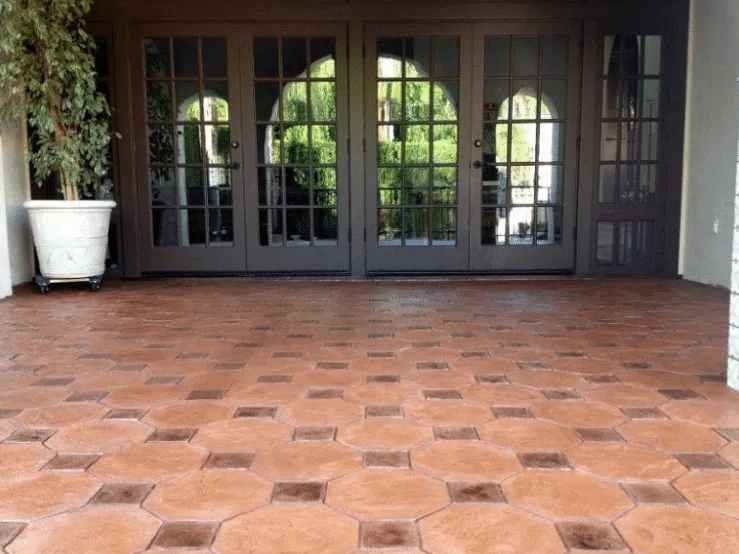
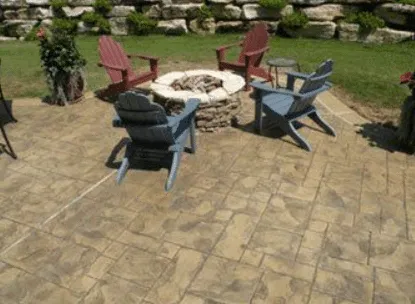
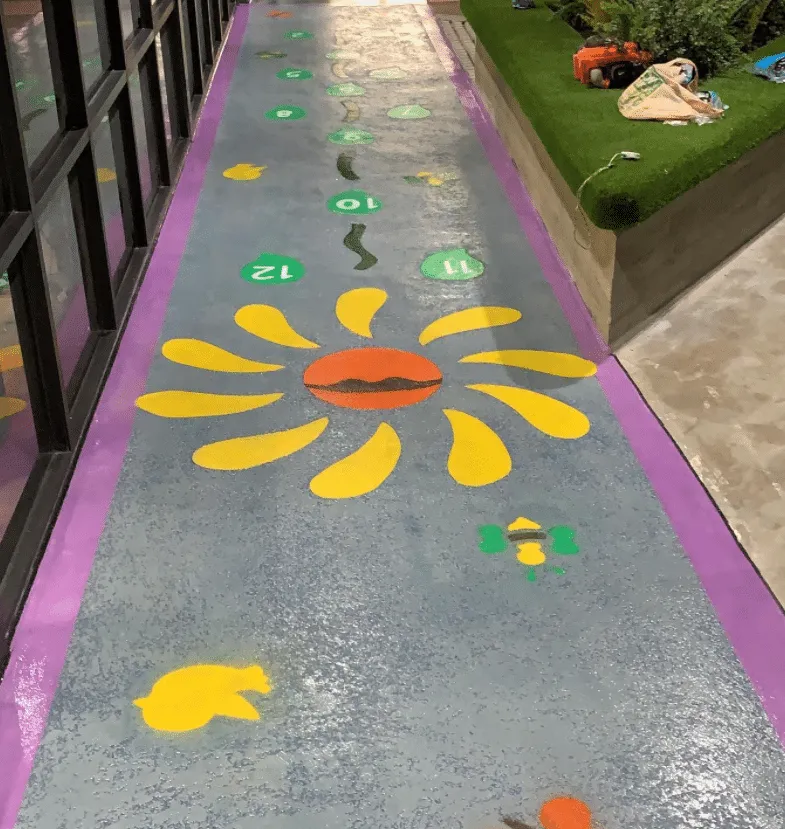
Photos from Concrete Polishing Solutions projects. Select a photo to view it larger.
View the photo galleryFAQ
Concrete overlay questions
Can an overlay go over cracked concrete?
Cracks and damaged areas are repaired before the overlay goes on. An overlay changes the surface; it does not fix problems in the slab, so cracks from movement or possible structural damage should be evaluated first.
Does an overlay need to be sealed?
Sealing is usually recommended. A new overlay can look great, but if it is not sealed it is easy to scratch or damage. See concrete sealing.
What is the difference between stamped concrete and a stamped overlay?
Stamping is done on newly placed concrete. A stamped overlay adds a pattern such as stone, brick or tile to concrete that is already in place.
Can an overlay be used on a wood deck or a wall?
Yes. Overlays can be applied to flat and vertical surfaces, and to other surfaces such as wood decks, once the surface is properly prepared.
Related
Related services
- Concrete ResurfacingRefinishing for worn concrete, including industrial and commercial floors under heavy use.
- Self LevelingA self-spreading, concrete-like material used as an underlayment or floor surface.
- Acid StainingDecorative stain applied after the concrete is cleaned or ground, to change the color of the floor.
- PatiosOutdoor patio surfaces and coatings.
Areas served
Serving homes and businesses across Southern California
- San Diego County
- Orange County
- Riverside County
- Los Angeles County
Free estimate
Ready to transform your concrete floor?
Share a few details about your space and the finish you have in mind, and we will help you choose the right system for your home or business.
- (619) 870-8308Call for a free estimate
- info@concretepolishingsolutions.proEmail us about your project
- Southern CaliforniaSan Diego, Orange, Riverside & Los Angeles counties