
Residential applications
Polished concrete interior floors
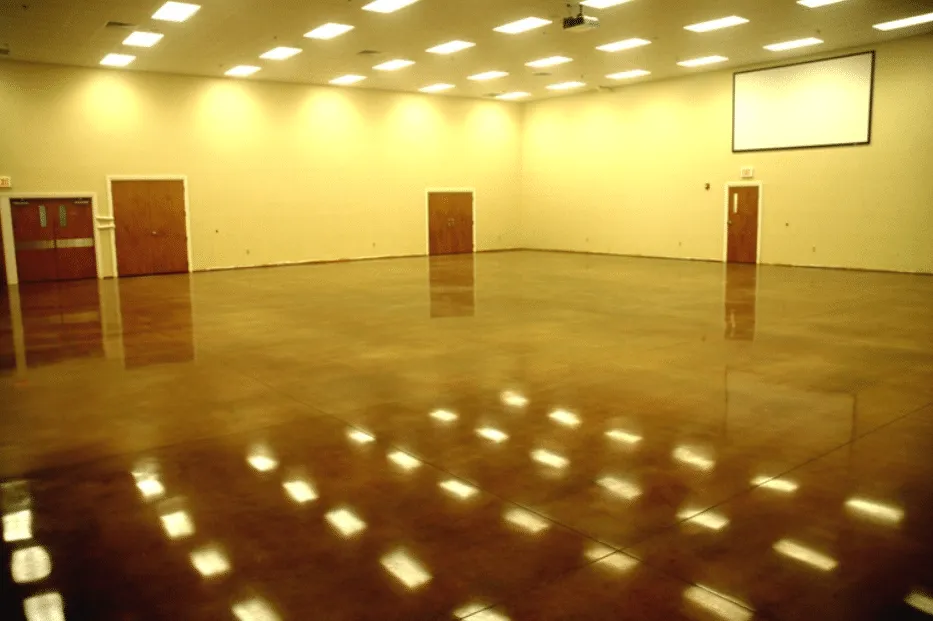
Polished and coated concrete floors for entryways, kitchens, bathrooms and living spaces, in glossy or matte finishes.
Overview
Concrete floors for living spaces
Polished concrete floors work well in garages, entryways, bathrooms and kitchens. The finish can be glossy or matte, giving each part of your home the surface texture that suits the space.
With polished or coated concrete, almost every room in a home can have a striking, low-upkeep floor. Stains add color, and metallic epoxy adds flowing color and movement.
Application at a glance
- Typical spaces
- Entryways, kitchens, bathrooms and living spaces
- Finish
- Glossy or matte, with a surface texture chosen for each room
- Design options
- Stains for color, or metallic epoxy for flowing color and movement
Room by room
Concrete floors in different rooms
A concrete floor can carry through most of a home, but each room asks something slightly different of it.
Entryways
The busiest doorway in the house. Grit tracked in from outside is the main thing to sweep up.
Kitchens and dining areas
Spills and daily cleaning. Polished or coated concrete wipes up easily and has no grout lines.
Bathrooms and living areas
The sheen can be chosen room by room, from matte to high gloss, so each space has the look you want.
Finish options
Design and finish options
Polished concrete gives a natural look in matte, satin or high gloss. Acid stains add color, metallic epoxy creates a statement floor, and self-leveling can serve as an underlayment or as the finished floor.
Choosing a finish
Polished concrete, stain or a decorative coating?
Polished concrete keeps the natural look of the slab. Stain adds color, metallic epoxy creates a decorative floor with flowing color and movement, and self-leveling can give an uneven slab a new finished surface.
| Finish | The look | Good to know |
|---|---|---|
| Polished concrete | Natural concrete from matte to high gloss; can be ground deeper to show the aggregate for a terrazzo-like look | Uses the existing slab; low maintenance, and a dull floor can be re-polished |
| Stained concrete | Rich, lasting color; acid stain gives a varied, marbled look, water-based stain a more uniform one | No two stained floors look exactly alike, because the concrete itself affects the color |
| Metallic epoxy | Swirls that can resemble stone, marble or water | A coating on top of the slab; the pattern varies from floor to floor |
| Self-leveling floor | A smooth new surface, with color added to suit your decor | Can fix an uneven surface without tearing out old concrete |
Polished concrete can also carry designs such as scoring, bands and borders. See finished floors in our photo gallery.
Existing floors
Reusing the concrete under carpet or tile
Many homes have a concrete slab under the current carpet, tile or vinyl. Once the old flooring is removed, that slab can often be polished, stained or coated, depending on its condition.
What is checked
- Leftover adhesive, sealer or wax, which is removed so a stain or coating can take
- Cracks, holes and old patches
- Low spots and uneven areas
- Whether the concrete has been resurfaced or sealed before, which affects how a stain takes
How it is prepared
The surface is ground to remove old residue and prepared for the finish you choose. Cracks and holes are repaired; where the floor is too uneven, a thin self-leveling layer can smooth it without replacing the slab.
Old patches and repairs can show through a polished or stained finish, which is worth talking through before choosing. See concrete grinding.
Our work
Interior floors
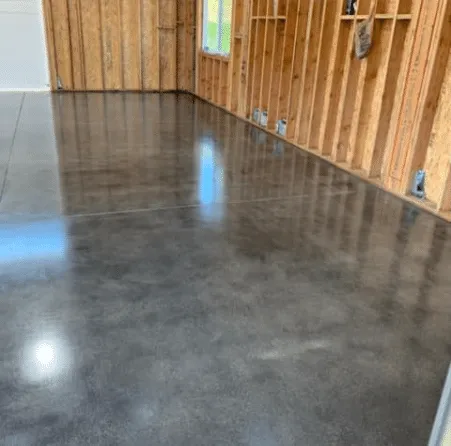
 Open larger photo: High-gloss polished concrete in a wood-framed room
 Open larger photo: Marbled metallic epoxy floor in a utility room
 Open larger photo: Polished concrete floor with a warm sheen
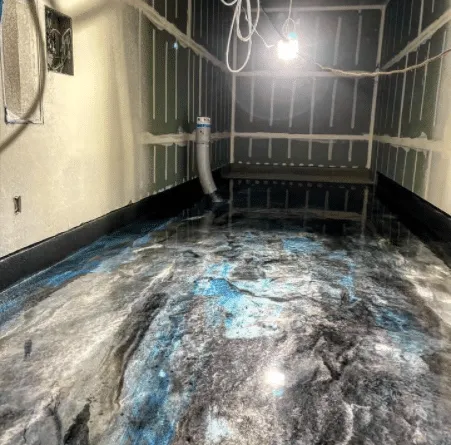
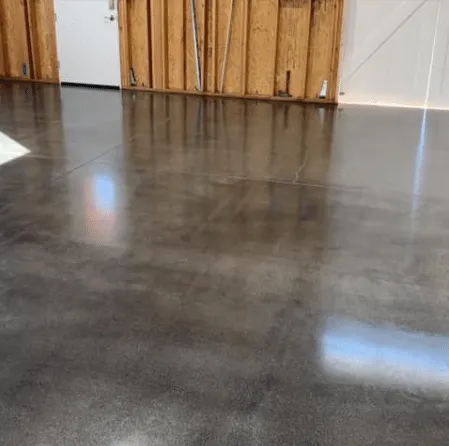
Photos from Concrete Polishing Solutions projects. Select a photo to view it larger.
View the photo galleryFAQ
Interior floor questions
Can my existing concrete be polished after the carpet comes up?
Often, yes. Existing floors in sound condition, including rough concrete, are ground, repaired where needed and then polished. Old adhesive is removed first, and the condition of the slab decides the exact steps.
Polished concrete or a coating for a living space?
Polished concrete keeps the natural look of the concrete and needs no coating. A decorative coating such as metallic epoxy changes the look completely. Stain sits in between, adding color while keeping the character of the slab.
Can a concrete floor have color or patterns?
Yes. Stains and dyes are the most common way to add color, and polished concrete can also have scoring, radial lines, grids, bands and borders. See acid staining.
How do I look after a polished concrete floor at home?
Sweep or dust-mop regularly and wet-mop occasionally with a suitable cleaner. When a busy area loses some of its shine, it can be restored by re-polishing. See the floor care guide.
Areas served
Serving homes and businesses across Southern California
- San Diego County
- Orange County
- Riverside County
- Los Angeles County
Free estimate
Ready to transform your concrete floor?
Share a few details about your space and the finish you have in mind, and we will help you choose the right system for your home or business.
- (619) 870-8308Call for a free estimate
- info@concretepolishingsolutions.proEmail us about your project
- Southern CaliforniaSan Diego, Orange, Riverside & Los Angeles counties